
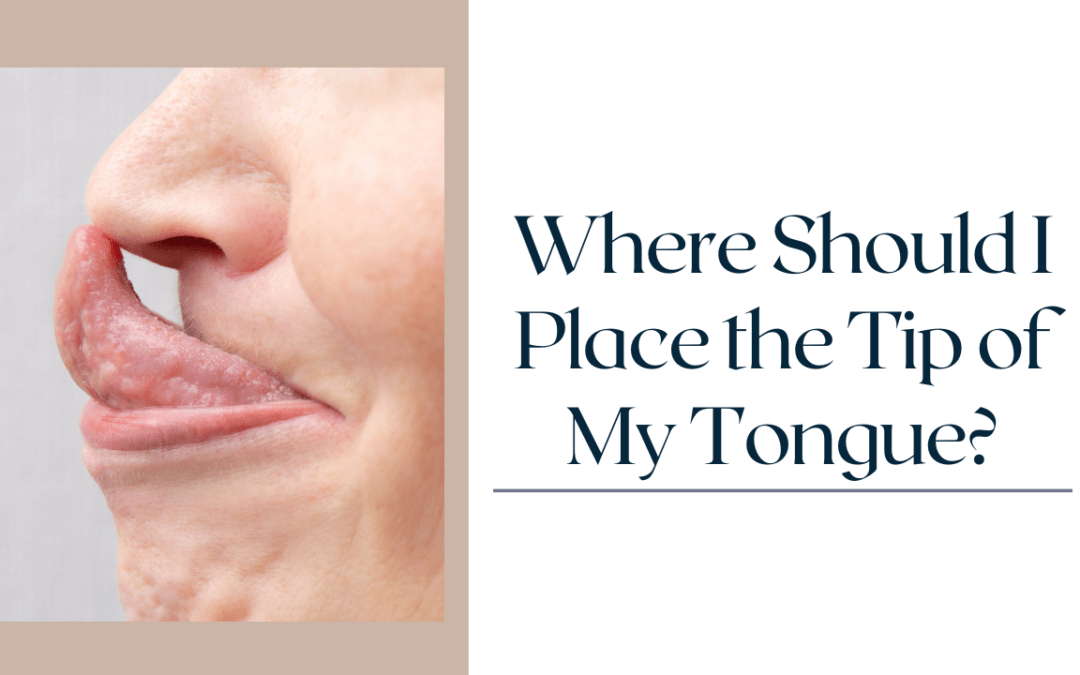
If you’re waking up tired no matter how many hours you slept — if your jaw aches, your mouth falls open at night, or you’ve been told your labs are “normal” but you still feel like garbage — there’s a good chance nobody has asked you a simple question: where does your tongue rest when your mouth is closed?
Most people have never thought about it. But tongue position at rest is one of the first things I check with every client, because a low, resting tongue is connected to mouth breathing, poor sleep, and a nervous system that never fully powers down. Here’s what “correct” tongue posture actually looks like, why it matters more than you’d think, and what to do about it.
What Does “Tongue on the Spot” Actually Mean?
Tongue on the spot means your tongue rests fully against the roof of your mouth — not just the tip, but the whole body of the tongue, from the ridge behind your top front teeth back toward your soft palate. Find the “speed bump” right behind your upper front teeth (the incisive papilla) — that’s your landmark.
Why This Matters for Your Sleep and Energy
When your tongue rests low instead of up, three things tend to happen:
- Mouth breathing takes over, which disrupts sleep quality even if you never fully wake up
- Your nervous system stays activated. The tongue-to-palate contact point is thought to help stimulate the vagus nerve — the nerve most connected to shifting your body out of fight-or-flight and into rest. A low tongue may mean that switch rarely gets flipped.
- Your airway and jaw development are affected over time, which can compound breathing and sleep issues rather than resolve them
How to Check Your Own Tongue Posture
Right now, notice: is your tongue touching the roof of your mouth, or is it sitting low, near your bottom teeth? Most people carrying chronic fatigue, jaw tension, or unrefreshing sleep are in the second group — and don’t know it.
Can I Just Fix This Myself?
Awareness is the first step, but a low tongue posture usually isn’t a habit you can white-knuckle your way out of. It typically requires retraining the muscle strength and neuromuscular pattern — which is the work we do together in myofunctional therapy. Trying to force correct posture without addressing the underlying strength and function is why most people who “try” on their own don’t see it stick.

How To Find “Tongue On the Spot”?
One of the first things that I teach my clients is “tongue on the spot”. The tip of the tongue should be on or near the incisive papilla behind your maxillary central incisors. Ok…now in English! Do you feel that “speed bump” behind the top, front teeth? That is the incisive papilla. This is a great landmark for the “spot”. However, I have my clients back the tongue up just a bit if the tongue is pressing up against the teeth too much.
Once I have taught my client how to find the spot, then one of the first exercises that I teach is the “Spot Rub”. With this exercise you are just rubbing the heck out of the spot with the tip of the tongue. (I call it the “pizza burn” or the “coffee burn” spot. I don’t know about you, but I’m pretty sure this is the same location that I always burn with pizza or coffee. Sigh…..)
Rubbing this spot starts to wake up that nerve ending and also teaches your tongue where to go. Now, this doesn’t happen overnight, and many of my clients have to work really hard to build the awareness, but with smartphones these days, there are so many apps that make awareness building easy. Many of my clients find a timer app of some sort that gently reminds them every 30 or 60 minutes to “tune in” and see where their tongue is.
What Does it Mean if My Tongue Isn’t On the Spot?
If your tongue is not on the spot, then it means that you have a low, resting tongue posture. A low tongue posture can be detrimental for a number of reasons. First, when the tongue is low it causes mouth breathing. Mouth breathing creates many concerns, some of which you can explore here.
[We also shamelessly suggest the Ultimate Guide To Breathing!]
Second, when the tongue is low, it isn’t in the roof of the mouth doing its job of “nature’s palatal expander”. The tongue is used to expand the upper arch, which in turn helps guide the shape of the lower arch. So, you can see how this works. The maxilla is like the lid on a box. If the upper arch gets a nice, wide “U” shape then the mandible will follow suit. If the tongue is low, then the craniofacial growth can be affected. Insufficient or incorrect craniofacial development is the reason that there is a sleep-disordered breathing crisis.
How Do I Correct My Tongue Posture?
What Happens Next?
If this sounds familiar — the exhaustion, the mouth breathing, the “why do I still feel awful” — the next step isn’t a free call or a guess. It’s a real exam.
Ready to find out what’s actually going on? The exam is a 60-minute virtual assessment with Carmen — a real clinical evaluation of your oral function, breathing, and sleep-related symptoms. You’ll leave with a written report and a clear next step.
Frequently Asked Questions
Is tongue posture the same as tongue-tie?
Not exactly. A tongue-tie can restrict how far your tongue is physically able to move, which can prevent correct resting posture. But you can have low tongue posture without a tongue-tie — it’s often a learned pattern from years of mouth breathing.
Can bad tongue posture really affect my sleep?
Tongue posture is one of several contributors to sleep quality that myofunctional therapy addresses — alongside nasal breathing and nervous system regulation. It’s rarely the only factor, but for many clients, it’s a significant piece nobody had connected for them before.
How long does it take to correct tongue posture?
This varies by person and depends on the underlying strength, structure, and habits involved — which is exactly what an exam is for. There’s no universal timeline we can promise before we’ve actually assessed you.
Do I need a diagnosis first?
No. Many of our clients come to us without a formal diagnosis — just years of feeling exhausted and no clear answer why. The exam is where we find out what’s actually going on.
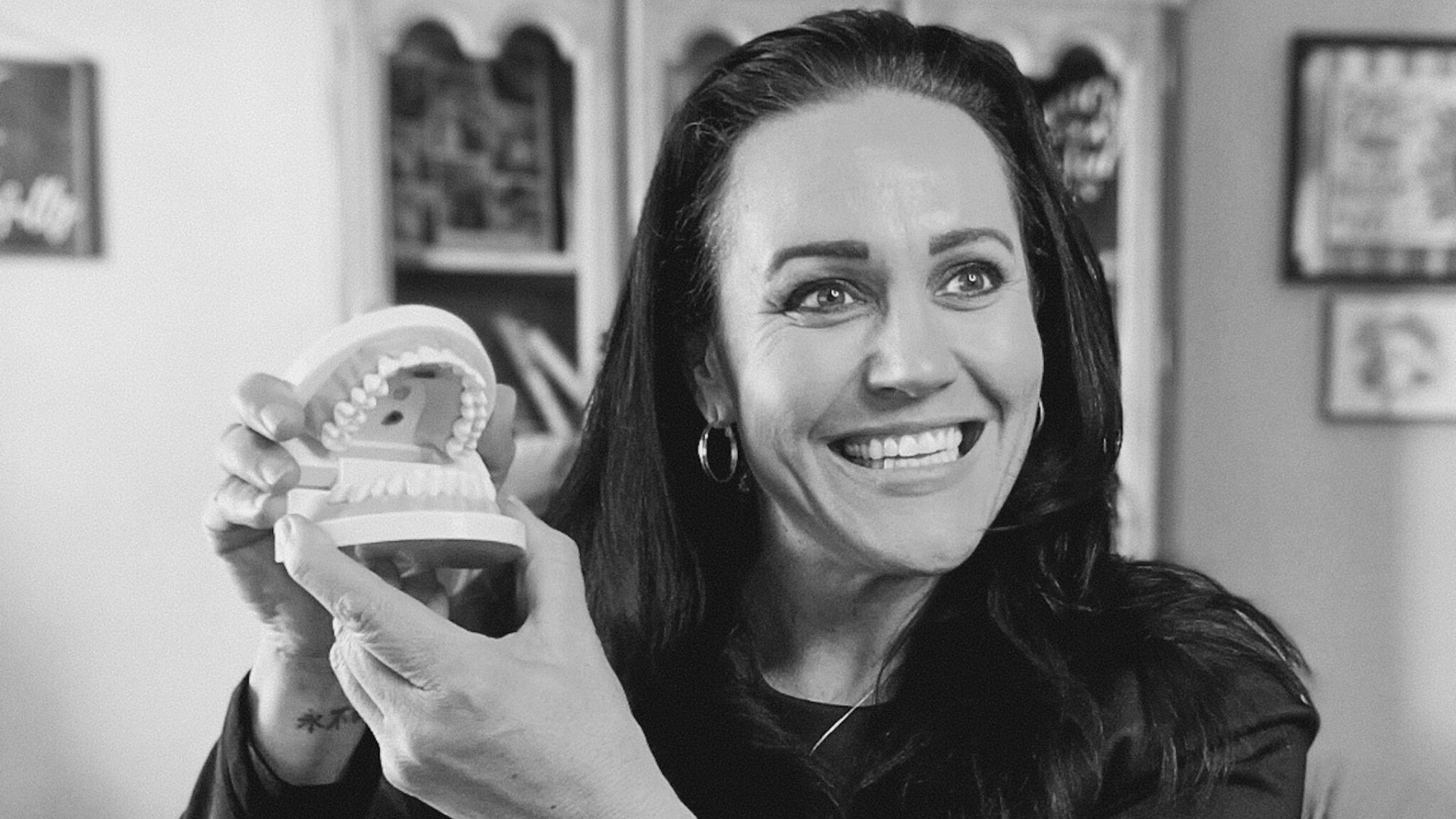


Meet Carmen Ball
I started as a dental hygienist. What changed everything was my own granddaughter — she was passed between doctors and therapists for years over her speech, breathing, sleep, and feeding issues, and no one connected the dots until I did: a significant tongue-tie, missed the whole time.
That’s the moment this stopped being a job and became the mission. Almost a decade ago, I left clinical hygiene to build Impact Myofunctional Therapy, and today I see clients all over the world — fully virtual, from wherever they are.
I’m an airway provider for the Foundation of Airway Health, where I work diligently for the recognition, diagnosis, and treatment of airway-related disorders.
And last but not least, I’m a proud member of several professional associations that afford me the opportunity to learn so that I can help you. My professional memberships include: