

If you’re trying to figure out how to find an airway orthodontist — for your child or for yourself — I get it. It’s not a Google search most people even know to run until something’s already gone wrong.
When I was a kid, braces weren’t a rite of passage — I was in college before my dad trusted me not to get my teeth knocked out on the basketball court. Like every other girl my age, I just wanted straight teeth and a good smile.
What nobody told me — not my dentist, not my orthodontist, not a single person — was that my low resting tongue, my open-mouth posture, and my mouth breathing were the actual reason my teeth were crowded in the first place. Braces alone were never going to fix that.
That’s what I spend my days on now: helping parents and adults understand not “how do we make teeth look straight” but “why did they get crooked, and how do we fix the actual cause.” If you’re here, you’re probably asking one of those questions — or you landed here looking for exactly what the title says. Let’s answer both.
In short: Airway orthodontics is an approach to orthodontic treatment that treats crooked teeth as a symptom of how the face and airway developed — not just a cosmetic problem. It matters for kids showing early signs of crowding or mouth breathing, and for adults whose past orthodontic treatment (especially extractions) may be connected to sleep, TMJ, or fatigue issues today. Impact Myofunctional Therapy helps you find and build the right care team — starting with a myofunctional exam.
How To Find an Airway orthodontist for Your Child
Why crooked teeth are worth a second look
Crooked teeth usually mean the bones of the face didn’t grow big enough to hold all the teeth in line. That’s not just a cosmetic issue — it can travel with:
- A smaller airway
- TMJ problems
- Open bite or cross bite
- Poor nasal breathing
- A high, narrow palate
- Sleep-disordered breathing or snoring
- Mouth breathing
Here’s a fact most parents have never heard: baby teeth are supposed to have gaps between them. That space is what makes room for the bigger adult teeth to come in straight. If your child’s baby teeth are already touching, that’s worth paying attention to — not as a guarantee of a problem, but as an early flag.
What age should my child see an orthodontist?
Most orthodontic associations recommend a first screening around age 7. In practice, that can be later than ideal. Watch for early signs — crowding, mouth breathing, snoring — and consider an airway-focused evaluation sooner if you’re seeing them. Some airway-focused providers begin early intervention as young as age 4 when it’s warranted. A child’s facial development is roughly 90% complete by age 10–12, with girls maturing earlier than boys — which is why “wait and see” isn’t always the safest default.
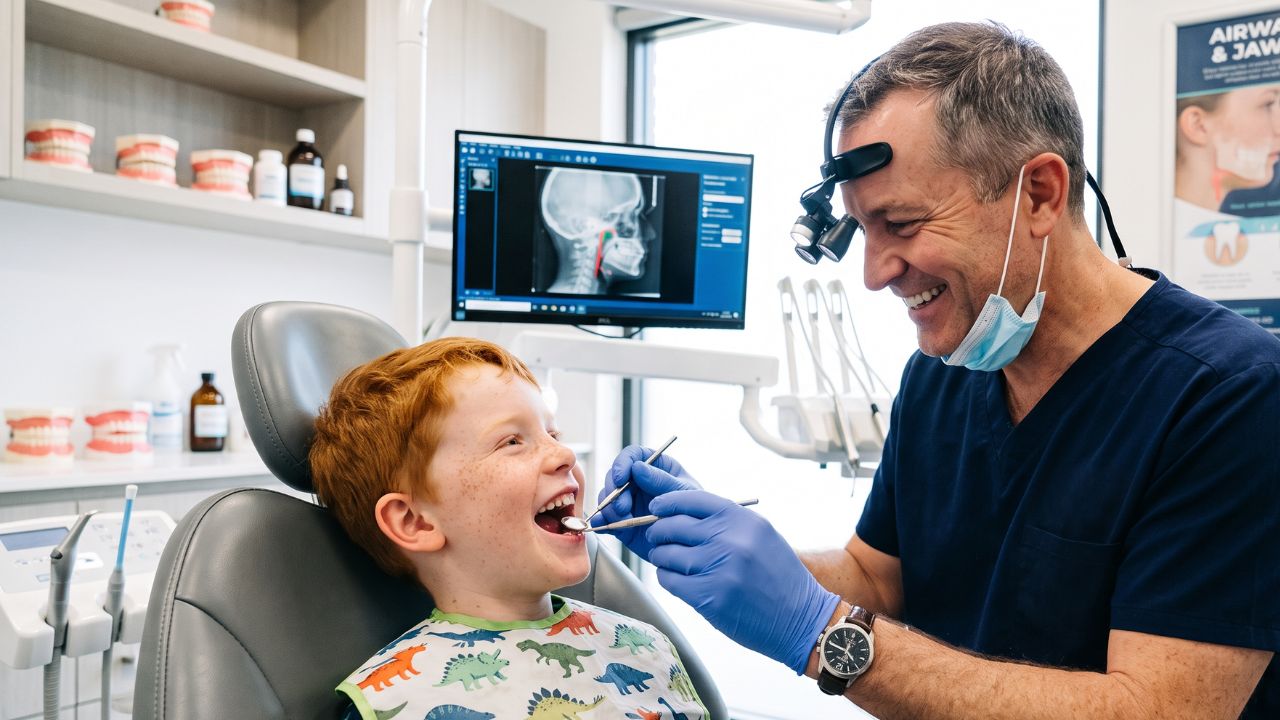
How To Find an Airway Orthodontist for an Adult
Airway orthodontics isn’t just for kids. It’s absolutely possible as an adult — it’s just a different (and usually slower) process, because you’re working with fully developed bone instead of a growing one.
A lot of adults reversing old orthodontic work are dealing with the same thing: a childhood extraction case. Pulling teeth to fix crowding was standard practice for decades — and it shrinks the space available for the tongue, which can shrink the airway along with it. If you had teeth pulled for braces as a kid or teen, and you’re now dealing with obstructive sleep apnea, poor sleep, daytime fatigue, TMJ pain, or just feeling like you can’t get ahead of exhaustion no matter what you try — this may be part of why.
It’s not a fast fix. But it’s a real one, and it starts with understanding whether it’s actually relevant to you.
What Airway Orthodontics Actually Looks Like
An airway-focused orthodontist isn’t just watching your teeth — they’re watching your facial development, your airway, and your sleep, and actively avoiding treatment that shrinks tongue space (like unnecessary extractions). The goal isn’t to make room for teeth by removing them — it’s to grow the space so all the teeth fit without being pulled at all.
Who should be on your airway team?
- A myofunctional therapist
- An airway-focused orthodontist or dentist
- A functional chiropractor or physical therapist (when indicated)
- A sleep physician (when indicated)
We help build this team. We work with a network of vetted specialists we can refer you to — but the starting point is always the same: a comprehensive myofunctional exam, so we understand what’s actually going on before we build the plan.
How To Find an Airway Orthodontist
If you want to start researching on your own before booking with us:
1. Google “airway orthodontics” + your city, then look at the practice’s website. If airway and breathing aren’t front and center, it’s not their focus. If the site is all cosmetic and whitening, keep looking.
2. Ask the right questions at the consult. Bring these:
- How does this practice screen for sleep and breathing problems?
- Do they take a root-cause approach to crowding, or a “just fix the teeth” approach?
- Do they routinely extract teeth to solve crowding?
- Do they understand — and believe in — airway-focused orthodontics, or is it a checkbox?
If extraction is the default answer to crowding, that’s a sign to get a second opinion.
Where This Starts
Every relationship with Impact Myofunctional Therapy starts the same way: a comprehensive myofunctional exam.
- 60 minutes, virtual — from anywhere
- Conducted personally by Carmen
- Not a consultation — a full assessment of oral function, breathing, and craniofacial patterns
After your exam, you’ll receive a written findings report and an offer for a spot in therapy. If we identify a need for an airway orthodontist or another specialist, we help you build that part of your team too.
FREQUENTLY ASKED QUESTIONS
Is airway orthodontics a real specialty?
It’s not a separate license — it’s a philosophy and approach some orthodontists and dentists specifically train in. Not every provider practices this way, which is part of why finding the right one matters.
Can adults really benefit from airway orthodontics?
Yes. It’s slower and more involved than treating a growing child, but meaningful improvement is possible for adults, including those reversing extraction-based orthodontic work from years ago.
Do I need to see an orthodontist before booking an exam with Impact Myofunctional Therapy?
No. Most clients start with us first. Your exam helps determine whether an airway-focused orthodontist or other specialist should be part of your plan — and if so, we help you find one.
What if I already have an orthodontist — do I need to switch?
Not necessarily. Bring the questions in this article to your existing provider. If they routinely extract teeth to solve crowding without addressing airway or facial development, that’s worth a second opinion.

Meet Carmen Ball
I started as a dental hygienist. What changed everything was my own granddaughter — she was passed between doctors and therapists for years over her speech, breathing, sleep, and feeding issues, and no one connected the dots until I did: a significant tongue-tie, missed the whole time.
That’s the moment this stopped being a job and became the mission. Almost a decade ago, I left clinical hygiene to build Impact Myofunctional Therapy, and today I see clients all over the world — fully virtual, from wherever they are.
I’m an airway provider for the Foundation of Airway Health, where I work diligently for the recognition, diagnosis, and treatment of airway-related disorders.
And last but not least, I’m a proud member of several professional associations that afford me the opportunity to learn so that I can help you. My professional memberships include: